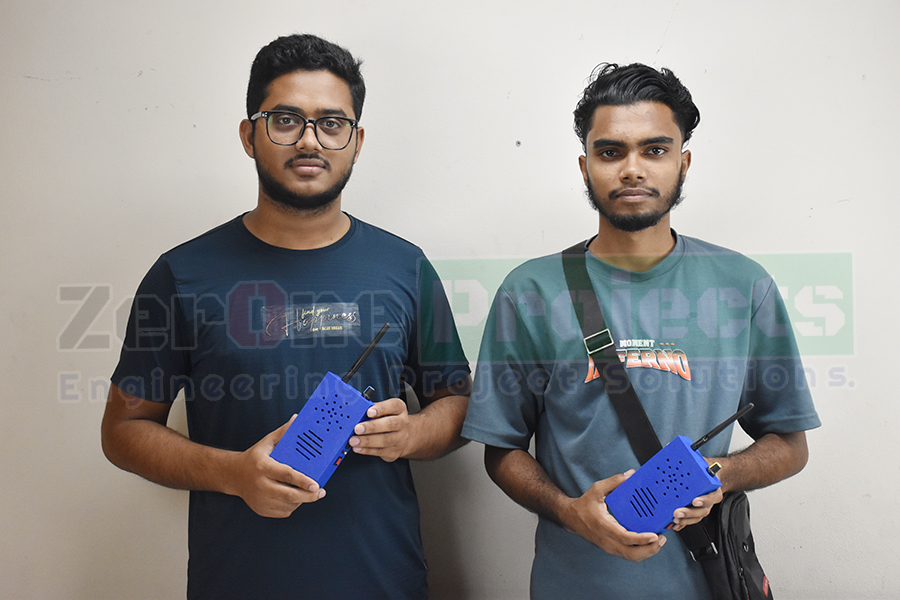
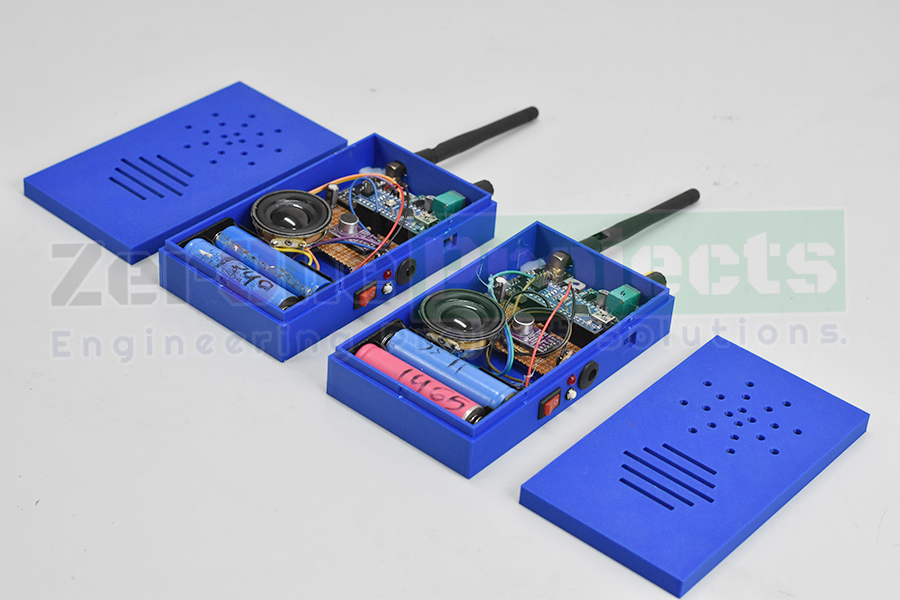
Two way Communication Walkie-Talkie.
Project Fee:Negotiable
Project Discount:0
Project Duration:7 Days
Two way Communication Walkie-Talkie.
The Two-Way Communication Walkie-Talkie is a wireless communication system designed to allow two or more users to exchange voice messages over a radio link without relying on a mobile network or internet connection. This project demonstrates the basic principles of wireless voice transmission and reception, making it useful for learning about radio communication and short-range communication systems.
To develop a wireless voice communication system.
To enable two-way communication between users.
To demonstrate radio signal transmission and reception.
To reduce dependence on mobile networks.
To explore practical wireless communication technology.
Assemble the audio transmission and reception circuits.
Connect a microphone and audio amplifier for voice input.
Integrate a radio-frequency transmitter and receiver.
Connect a speaker and amplifier for audio output.
Provide a suitable battery-powered supply.
Test voice clarity, communication range, and signal stability.
RF Transmitter Module
RF Receiver Module
Microphone
Speaker
Audio Amplifier Circuit
Antenna
Push-to-Talk Switch
Battery
Control Circuit
Enclosure
When a user presses the push-to-talk switch and speaks into the microphone, the voice is converted into an electrical audio signal. The transmitter sends the signal through a radio link to the receiving unit. The receiver processes the signal, and the speaker converts it back into audible sound. For two-way communication, each unit must support both transmitting and receiving, with users taking turns to speak.
Wireless voice communication
No internet required
Portable and convenient
Useful for short-range coordination
Battery-powered operation
Practical radio communication learning
The Two-Way Communication Walkie-Talkie project demonstrates how radio technology enables direct voice communication between users. It provides a practical introduction to audio processing, radio transmission, and signal reception. Communication range and clarity depend on the radio modules, antennas, surrounding environment, and power supply. The selected radio frequency and transmitter power should comply with local regulations
🔰 ইঞ্জিনিয়ারিং ফাইনাল ইয়ার প্রজেক্টস এবং স্কুল-কলেজের ছাত্র ছাত্রীদের বিজ্ঞান মেলায় প্রতিযোগিতা করার জন্য, পছন্দের তালিকায় রাখতে পারেন আমাদের নিজিস্ব ডিজাইনের তৈরি এই ডেমো প্রজেক্ট গুলো। আমাদের রয়েছে সফলতার সাথে ১০০০+ প্রজেক্ট সম্পন্ন করার অভিজ্ঞতা।
🔰 আপনার প্রজেক্টের আইডিয়া, সম্পূর্ণ প্রজেক্ট, প্রজেক্ট পেপার, পাওয়ার পয়েন্ট প্রেজেন্টেশন এবং আপনার প্রজেক্ট ভাইবা পর্যন্ত সকল ধরণের কারেকশন, সহযোগিতা করার জন্য আমাদের টিম আছে আপনার সাথে।
🔰 প্রতিনিয়ত আমরা আপনাদের জন্য বেস্ট সার্ভিস আর আপনাদের চাহিদা অনুযায়ী প্রজেক্ট তৈরি করে আপনাদের হাতে পৌঁছে দেওয়ার জন্য করে যাচ্ছি অক্লান্ত পরিশ্রম। আপনাদের রেসপন্সে আমরা অভিভূত।
𝐂𝐨𝐧𝐭𝐚𝐜𝐭 𝐃𝐞𝐭𝐚𝐢𝐥𝐬:
📞 01894-801150, 01886-180101
📧Email: projects.zeronebd@gmail.com
🌐Web: https://www.projects.zeronebd.com
YouTube Channel: https://www.youtube.com/c/ZerOneProjects
Instagram: www.instagram.com/zerone_projects_bd
🏠অফিস:
প্লট-০৩, রোড -০৪, সেকশন ৬/ক
মিরপুর-২ (মিরপুর শের-ই-বাংলা স্টেডিয়ামের ৪নং গেটের বিপরীতে),
ঢাকা-১২১৬
Copyright ©2023 ZerOne IT Limited. All Rights Reserved.