
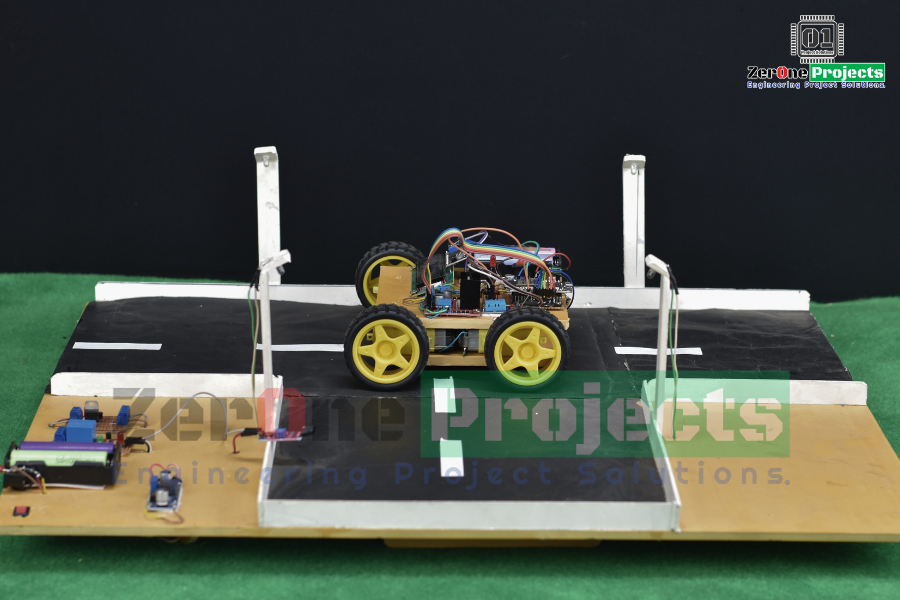

IoT Based Solar Wireless Charging Systems for Electric Vehicles.
Project Fee:Negotiable
Project Discount:0
Project Duration:One Month
Introduction
l The IoT Based Solar Wireless Charging System for Electric Vehicles focuses on providing a clean, sustainable, and cable-free EV charging solution using solar energy.
l It combines wireless power transfer and IoT technology to enable safe, efficient, and intelligent charging without physical connectors.
l Solar panels act as the primary energy source, reducing dependence on grid electricity and fossil fuels.
l Real-time monitoring through IoT enhances user convenience, system automation, and suitability for smart city applications.
OBJECTIVES
l To design a solar-powered wireless EV charging system using renewable energy.
l To remove physical cables through inductive wireless charging for safer and easier operation.
l To implement IoT-based real-time monitoring of charging and battery parameters.
l To allow remote access and control via cloud or mobile applications.
l To support eco-friendly transportation by minimizing grid power usage.
l To improve user safety and system reliability by avoiding sparks and connector wear.
l To validate a smart EV charging solution suitable for parking areas and smart cities.
REQUIRED COMPONENT
l Battery
l Buck Conveter
l Wireless Coil
l IR sensor
l Relay
l LCD Display
l Solar panel
l Node MCU
l BO Motor
l Motor driver
l Temperature Senosr
WORKING PRINCIPLE
The IoT Based Solar Wireless Charging System for Electric Vehicles operates using a transmitter side and a receiver (vehicle) side. On the transmitter side, the solar panel converts sunlight into electrical energy, which is stored in a battery. A buck converter regulates the voltage to the required level for stable operation. An IR sensor detects the presence of the vehicle on the charging pad and activates a relay, which switches ON the transmitter circuit. The transmitter generates high-frequency power and energizes the transmitter coil, creating an alternating magnetic field.
On the receiver side, the receiver coil mounted on the vehicle captures this magnetic field through inductive coupling and converts it into electrical energy. A buck converter regulates the voltage to the required level for stable operation. A temperature sensor monitors battery temperature, while the NodeMCU processes system data and enables IoT monitoring. Charging status and parameters are displayed on an LCD. The motor driver controls the gear motors, enabling wheel movement during vehicle operation.
ADVANTAGES
l Smart Electric Vehicle charging system.
l Pollution Free
l Low maintenance Cost.
l Magnetic field radiation problem is avoided
l The system is user friendly.
l Eliminates shock and tripping risks
l Charges while parked or in motion
l Functions in rain or snow
l Making it easy to charge without plugging .
CONCLUSION
The IoT-based solar wireless charging system provides a safe, eco-friendly, and intelligent EV charging solution. By combining solar energy, wireless power transfer, and IoT monitoring, it ensures efficient, automated, and convenient charging, suitable for smart cities and sustainable transportation.
 ০১৬৭৬-৯৯৮০৯৯, ০১৭১৪-৮০৮৪০২
 Office :
 e-mail: projects.zeronebd@gmail.com
Copyright ©2023 ZerOne IT Limited. All Rights Reserved.